Table of Contents
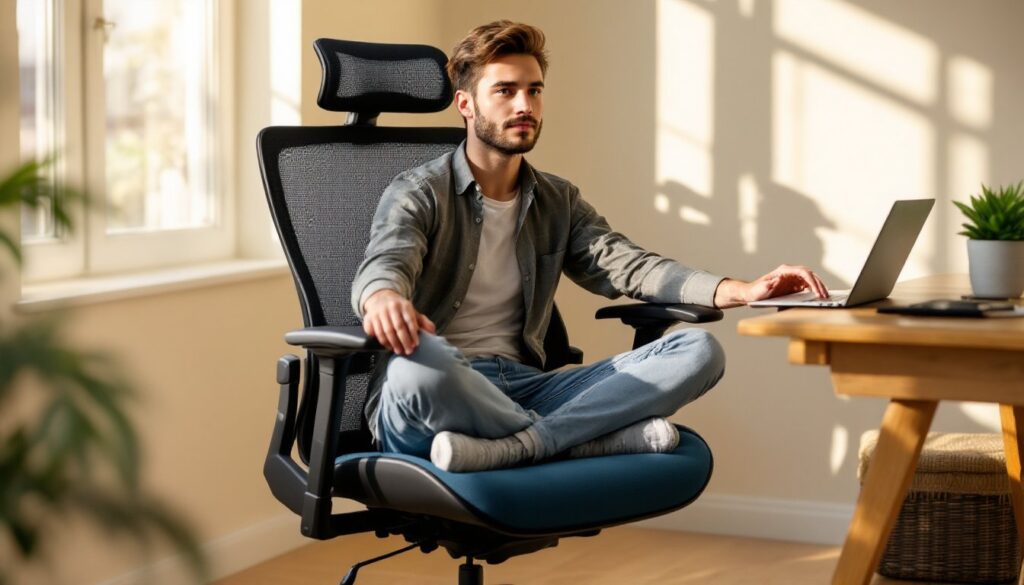
ToggleCross-legged sitting isn’t just a meditation pose, it’s how many people naturally prefer to work when comfort matters more than corporate formality. But most office chairs weren’t designed for it. Standard seating forces knees against armrests, leaves legs dangling uncomfortably, or restricts movement so much that sitting cross-legged becomes a contortionist act. The result? Pressure points, circulation issues, and constant fidgeting. A proper cross-legged office chair eliminates those problems with wider seats, strategic armrest placement, and enough depth to support flexible postures without sacrificing lumbar support or stability.
Key Takeaways
- An office chair for cross-legged sitting requires a wider seat (20–24 inches) and proper depth adjustment (18–21 inches) to prevent circulation issues and maintain lumbar support.
- Adjustable or flip-up armrests are essential—fixed armrests block knee clearance, so look for 4D-adjustable arms that spread 22–24 inches apart or removable options.
- Seat height should be 2–4 inches lower than standard desk positioning when sitting cross-legged to keep thighs parallel to the floor and maintain proper spinal alignment.
- Medium-density foam cushions (1.8–2.0 lbs/ft³) or breathable mesh distribute weight evenly and prevent pressure hotspots that compress blood vessels during cross-legged postures.
- Wide-seat task chairs and gaming chairs with bucket-style designs offer practical cross-legged functionality, while floor chairs work best for low-desk setups.
- Proper adjustment of a cross-legged office chair—including seat tilt, lumbar support positioning, and armrest configuration—eliminates discomfort and allows seamless transitions between seated positions.
Why Cross-Legged Sitting Needs a Special Office Chair
Standard office chairs follow industry dimensions that assume feet on the floor: seat widths between 17–20 inches, seat depths around 16–18 inches, and armrests positioned to bracket the body at hip width. Those specs collapse the moment someone tucks their legs up.
Cross-legged sitting demands at least 20–24 inches of usable seat width to accommodate both legs without compressing thighs against the chair frame. Depth matters too, shallow seats force knees to overhang the front edge, cutting off circulation, while too-deep seats leave the lower back unsupported. Aim for 18–21 inches of depth with adjustable lumbar support that still engages when sitting farther back.
Armrests become obstacles rather than supports. Fixed arms at standard height (7–10 inches above the seat) block knee clearance. Even worse, narrow armrest spacing, typically 19–20 inches apart, creates a cage that prevents leg repositioning.
Body mechanics shift dramatically when legs fold. The pelvis tilts forward slightly, increasing lumbar curve and shifting weight distribution. Chairs with minimal seat pan tilt adjustment (ideally 0–5 degrees forward) help maintain neutral spine alignment. Without it, users either slouch to compensate or perch uncomfortably on the front third of the seat.
Circulation also changes. Feet-on-floor sitting relies on gravity and muscle engagement to return blood from the legs. Cross-legged posture compresses vessels at different points, behind the knees, at the ankles, across the inner thighs. Seat cushion firmness matters here: too soft creates pressure hotspots, too firm restricts blood flow. Medium-density foam (around 1.8–2.0 lbs/ft³) or breathable mesh distributes weight more evenly.
Key Features to Look for in a Cross-Legged Office Chair
Seat Width and Depth Considerations
Measure twice, buy once. Sit cross-legged on the floor or a flat surface and measure the maximum width your legs occupy from outer knee to outer knee. Add 2–3 inches of clearance on each side for comfort and fabric compression. Most cross-legged-friendly chairs start at 20 inches wide, but larger users may need 22–24 inches.
Seat depth adjustability isn’t optional, it’s critical. Look for pneumatic depth adjustment with at least 2–3 inches of forward/backward travel. This lets users slide the seat forward when sitting cross-legged to maintain lumbar contact without forcing thighs against the front edge. Fixed-depth chairs lock users into one position, which defeats the purpose of flexible seating.
Waterfall-edge seat pans reduce pressure on the back of the thighs when legs unfold. The front edge curves downward slightly, preventing the hard 90-degree corner found on cheaper chairs. This detail becomes noticeable during long work sessions when alternating between cross-legged and standard sitting.
Material choice affects how much usable space exists. Thick upholstery with dense padding can consume 1–2 inches of nominal seat width. Modern design approaches increasingly favor breathable mesh or thinner foam over plush cushioning for better dimensional consistency and temperature regulation.
Armrest Design and Adjustability
Armrests should move out of the way or disappear entirely. 4D-adjustable armrests, height, width, depth, and pivot, allow positioning that clears knees without removing support when typing or mousing. Width adjustment is non-negotiable: armrests need to spread at least 22–24 inches apart to accommodate crossed legs.
Flip-up armrests offer a simpler solution: lift them out of the way entirely when sitting cross-legged, lower them for traditional desk work. The hinge mechanism should lock firmly in both positions without rattling or gradual drift.
Some users prefer armless chairs altogether. Removing armrests eliminates obstruction but sacrifices upper body support during keyboard-intensive tasks. This works best for users who alternate between a cross-legged chair and a standing desk or who rarely use armrests anyway.
Armrest padding thickness matters more than it seems. Bulky padding adds width that blocks leg movement. Slim, firm armrests (under 1 inch thick) maintain support while minimizing intrusion. Check clearance between armrest bases, some chairs have wide mounting brackets that reduce effective seat width even when arms adjust outward.
Top Office Chair Styles That Support Cross-Legged Sitting
Wide-seat task chairs dominate the cross-legged category. These modify standard ergonomic designs with broader seat pans (20–24 inches), roomier arm spacing, and often omit bolstered side wings found on executive chairs. Look for models advertising “big and tall” or “oversized” dimensions, they’re engineered for larger frames but work equally well for flexible sitting.
Gaming chairs adapted to office use offer surprising cross-legged functionality. Their bucket-style seats with high sides seem counterintuitive, but many use widths of 21–23 inches and include removable lumbar pillows that accommodate varied postures. The aggressive styling won’t suit every workspace aesthetic, but functionality trumps appearance for home offices.
Kneeling chairs and saddle stools split opinion. Kneeling chairs shift weight to the shins, which prevents cross-legged sitting but encourages active posture changes. Saddle stools allow asymmetric leg positions, not quite cross-legged, but more flexible than standard chairs. Both work better as secondary seating rotated throughout the day rather than all-day solutions.
Floor chairs and cushions represent the opposite extreme: no structure, maximum flexibility. Japanese-style floor chairs with adjustable backs combine cross-legged comfort with lumbar support but require low desks or lap desks. Not practical for traditional desk setups, but viable for households already using floor-level work surfaces.
Mesh-back chairs with wide seats balance breathability and dimension. Full-mesh designs (seat and back) eliminate the padding thickness that robs usable width. They also improve airflow during long sessions, cross-legged sitting traps more body heat than standard posture. Mesh tension should be adjustable to prevent the hammock effect that bottoms out under shifted weight distribution.
Budget-friendly modifications include adapting standard furniture with wider aftermarket cushions or removing armrests entirely. This works for occasional cross-legged sitting but lacks the integrated adjustability of purpose-built chairs. The cost savings (often $100–$300) may justify compromises for users not sitting cross-legged full-time.
Setting Up Your Chair for Maximum Cross-Legged Comfort
Start with seat height adjustment. Cross-legged sitting raises your hip point by several inches, more if sitting on a thick cushion. Lower the seat so thighs remain parallel to the floor or tilt slightly downward when legs are folded. This typically means 2–4 inches lower than standard desk height positioning. Desk height may need adjustment too: elbows should still rest at 90 degrees when typing.
Lumbar support positioning shifts downward and sometimes forward. When sitting cross-legged, the pelvis rotates slightly forward, changing where the lower back contacts the chair. Adjust lumbar depth (if available) to push support forward 1–2 inches, and lower height adjustment so the support hits at belt level rather than mid-back. Test by sitting cross-legged for 10–15 minutes, proper adjustment eliminates the urge to arch or slouch.
Seat pan tilt requires trial and error. A slight forward tilt (1–3 degrees) helps maintain spinal alignment for some users, while others prefer a level or slightly rearward tilt. Avoid extreme forward tilt, it creates a sliding sensation and forces constant muscle engagement to stay upright. Lock the tilt once you find the sweet spot: free-floating tilt mechanisms can shift unexpectedly when changing leg positions.
Armrest setup depends on whether you’re using them. For 4D arms: widen to maximum spacing, lower to minimum height or just below desk level, and angle pads outward slightly. They should support forearms during typing without contacting your body when sitting back. For flip-up arms, establish a repeatable locked position so they return to the same spot each time.
Test the full range of motion your chair allows. Sit cross-legged in several variations: left leg over right, right over left, loosely folded, tightly tucked. A properly adjusted chair accommodates all positions without requiring readjustment. If you’re constantly tweaking settings, something’s wrong, likely seat width, depth, or armrest clearance.
Safety check: Verify the chair’s weight capacity supports shifted load distribution. Cross-legged sitting concentrates weight in the center of the seat rather than distributing it front-to-back. Chairs rated for 250+ lbs typically use reinforced bases and mechanisms that handle asymmetric loading better than budget models rated for 200 lbs or less.
Conclusion
Finding the right office chair for cross-legged sitting comes down to dimensions, adjustability, and honest assessment of how often the posture gets used. Measure actual body dimensions before shopping, prioritize width and depth over cushion thickness, and don’t compromise on armrest clearance. The initial setup takes time, but proper adjustment prevents the circulation issues and discomfort that make cross-legged sitting impractical in standard chairs.