Table of Contents
ToggleThat squeaky pneumatic cylinder or torn armrest doesn’t necessarily mean it’s time to drop $400 on a new chair. Whether it’s a high-end ergonomic model or a reliable mid-range seat, many office chairs are built to last a decade or more, if you’re willing to repair them. The question is whether to hunt down a local repair pro or tackle the fix yourself. This guide walks through how to evaluate the damage, find qualified technicians in your area, understand what repairs cost, and identify which jobs you can knock out in your garage with basic tools.
Key Takeaways
- Office chair repair near me makes financial sense when the frame is solid and parts are available—repairs typically cost $60–$200 compared to $200–$400 for replacement.
- Find professional office chair repair services by searching Google or Yelp, contacting commercial furniture dealers like Steelcase or Herman Miller, or asking local coworking spaces for referrals.
- Common DIY repairs like gas cylinder and caster replacement can be completed in under an hour with basic tools, saving $50–$100 in labor costs.
- Always verify technicians are factory-trained for high-end ergonomic chairs and request a written estimate that separates labor and parts before approving work.
- Replace your chair when the frame is cracked, multiple components fail simultaneously, or total repair cost exceeds 60% of a comparable new chair’s price.
When to Repair vs. Replace Your Office Chair
Start with a cost-benefit calculation. If the chair originally retailed under $150 and has significant frame damage, replacement usually makes more sense. But if you own a $500+ ergonomic chair with a failing gas cylinder or worn casters, a $75–$150 repair pays for itself.
Repair makes sense when:
- The chair frame is solid with no cracks or welds breaking
- Replacement parts are readily available (Class 4 gas cylinders, standard 2-inch casters, armrest pads)
- The upholstery is intact or the rip is confined to one removable panel
- The tilt mechanism engages smoothly without metal-on-metal grinding
Replace when:
- The seat pan or backrest frame is cracked (structural failure that compromises safety)
- Multiple components are failing simultaneously (gas cylinder, casters, armrests, and upholstery)
- The chair predates modern ergonomic standards (no lumbar support, fixed armrests, limited adjustability)
- Total repair cost exceeds 60% of a comparable new chair’s price
Check the chair’s manufacturing date, usually stamped on the underside of the seat pan or on the gas cylinder label. Most quality chairs carry a 5–10 year warranty on structural components: if you’re still within that window, contact the manufacturer before paying for repairs out of pocket.
How to Find Professional Office Chair Repair Services Locally
Office chair repair shops aren’t as common as appliance repair services, but they exist, especially near commercial districts. Start with furniture repair specialists rather than general upholstery shops: they’ll have the pneumatic cylinders, tilt mechanisms, and caster sets in stock.
Search strategies that work:
- Use Google or Yelp with “office chair repair” + your city name, or search local furniture repair professionals to compare ratings and availability
- Call commercial office furniture dealers (Steelcase, Herman Miller, Hon): many offer repair services or can recommend certified techs
- Check with local coworking spaces or corporate facilities managers, they often have repair contacts for fleet maintenance
- Post in neighborhood Facebook groups or Nextdoor: someone’s likely used a mobile repair tech
What to ask before booking:
- Do they stock parts for your chair brand, or will they need to order them (adds 1–2 weeks)?
- Is there a diagnostic fee, and does it apply toward the repair if you proceed?
- Do they offer mobile service, or do you need to drop off the chair?
- What’s the warranty on labor and parts (30–90 days is standard)?
For high-end ergonomic chairs like Herman Miller Aeron or Steelcase Leap, verify the tech is factory-trained or an authorized service provider. Generic repair shops can handle gas cylinders and casters, but adjusting synchro-tilt tension or replacing mesh panels requires model-specific knowledge.
If local options are thin, consider platforms like Angi or ImproveNet, which aggregate contractor and repair service reviews along with project cost benchmarks. Filter results by “furniture repair” and read recent reviews, look for mentions of office chair work specifically, not just antique restoration or reupholstery.
What to Expect from Professional Repair Services
Most repair shops start with a diagnostic inspection, either at their shop or on-site if they offer mobile service. Expect to pay $40–$75 for the diagnostic if you don’t proceed with repairs, though many shops waive this fee if you approve the work.
Typical turnaround times:
- Simple repairs (gas cylinder, casters, armrest pads): same-day to 2 days
- Tilt mechanism replacement or upholstery panel: 3–7 days
- Custom upholstery or hard-to-source parts: 2–4 weeks
A good tech will walk you through what’s failing and why. For instance, if your gas cylinder won’t hold height, they should check whether the cylinder itself is blown or if the chair’s control lever is stripped. If the mechanism’s plastic sleeve is cracked, replacing just the cylinder won’t solve the problem.
Ask for a written estimate that breaks out labor and parts separately. Labor rates typically run $60–$100 per hour, with most jobs taking 0.5–1.5 hours. Parts pricing varies wildly: a generic Class 4 gas cylinder costs $25–$40, while a Herman Miller-specific cylinder runs $80–$120.
Reputable shops carry general liability insurance and warranty their work for at least 30 days. If a tech shows up without a business card or refuses to provide a receipt, walk away, you’ll have no recourse if the repair fails or damages the chair further.
DIY Office Chair Repairs You Can Tackle at Home
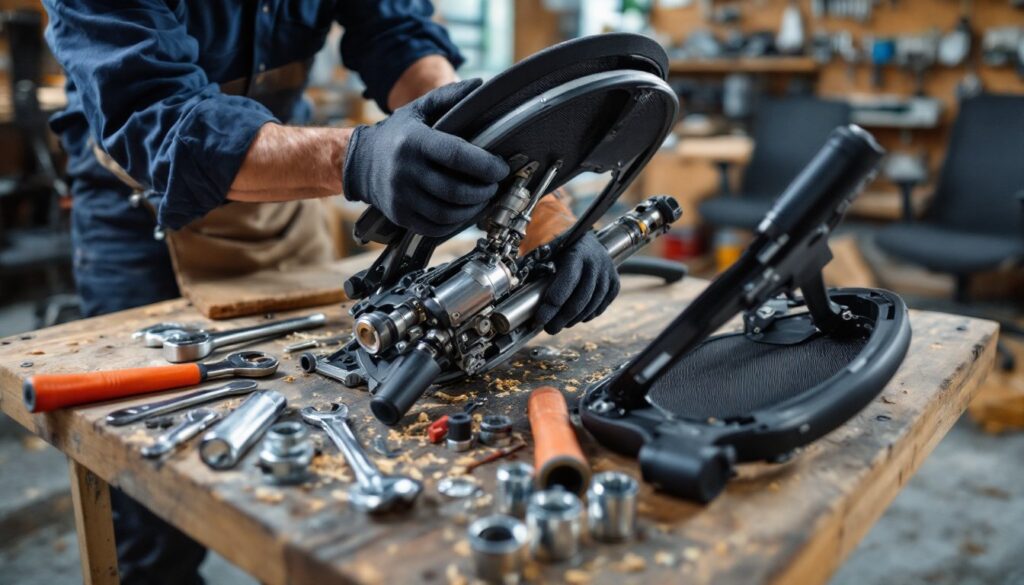
Many common office chair failures don’t require specialized tools or skills. If you can operate a socket wrench and follow a YouTube tutorial, you can handle the majority of repairs in under an hour.
Tools you’ll need:
- Adjustable wrench or socket set (10mm and 13mm sockets cover most bolts)
- Flathead screwdriver and Phillips #2
- Rubber mallet (for tapping in tilt mechanism pins)
- Pipe wrench or strap wrench (for stubborn gas cylinder removal)
- Safety glasses (pneumatic cylinders are pressurized, wear eye protection)
Safety warning: Never attempt to disassemble or cut open a gas cylinder. They contain compressed nitrogen and can cause serious injury if punctured. Always remove and dispose of cylinders intact.
Common Repairs and Replacement Parts
Gas cylinder replacement is the most frequent DIY repair. If your seat slowly sinks during use or won’t adjust at all, the cylinder’s seal has failed. Order a replacement by measuring the cylinder’s stroke length (distance from top to bottom in compressed position) and diameter. Most office chairs use a Class 4 cylinder (also called “heavy-duty” or “big and tall”), rated for 250+ lbs. Avoid cheap Class 2 cylinders unless you weigh under 175 lbs, they’ll fail again within months.
- Flip the chair upside down and remove the base (usually held by a retaining clip or simply friction-fit)
- Tap the cylinder out of the tilt mechanism using a rubber mallet and a block of wood to protect the mechanism
- Slide the new cylinder into the mechanism until it clicks or seats fully
- Reattach the base and test the height adjustment lever
Caster replacement takes five minutes. Measure your current casters’ stem diameter (most are 7/16-inch or 11mm grip-ring stems). If you’re on hardwood floors, swap standard nylon wheels for rollerblade-style polyurethane casters, they roll smoother and won’t scratch the finish. Just pull the old casters straight out and press the new ones in until they snap.
Armrest pads wear out or crack from UV exposure and body oils. Most aftermarket pads attach with screws through the underside of the armrest frame. Measure the screw-hole spacing (commonly 3.5 or 4 inches) before ordering replacements.
Tilt mechanism replacement is more involved but doable. Remove the seat pan (usually four bolts), disconnect the gas cylinder, unbolt the old mechanism, and reverse the process with the new part. Make sure to order the correct mechanism type, synchro-tilt, knee-tilt, and multi-function mechanisms aren’t interchangeable.
Cost Comparison: Professional Repair vs. DIY vs. Replacement
Here’s a realistic breakdown for the most common office chair failures, based on 2026 pricing:
Gas cylinder repair:
- Professional: $80–$150 (includes $25–$40 cylinder + $50–$100 labor)
- DIY: $25–$50 (parts only: 20–30 minutes)
- New mid-range chair: $200–$400
Caster replacement (set of 5):
- Professional: $60–$100 ($15–$30 parts + $40–$70 labor)
- DIY: $15–$35 (parts only: 5 minutes)
- New chair: $200–$400
Tilt mechanism replacement:
- Professional: $120–$200 ($40–$80 mechanism + $80–$120 labor)
- DIY: $40–$90 (parts only: 30–45 minutes)
- New chair: $200–$400
Full reupholstery (seat and back):
- Professional: $180–$350 (labor-intensive: requires fabric, foam, and 2–4 hours)
- DIY: $40–$100 (fabric and foam: 2–3 hours and moderate sewing skills)
- New chair: $200–$400
Break-even calculation: If your chair originally cost $300 or more and only needs one or two repairs, fixing it saves money even using a pro. If it needs a gas cylinder, new casters, and reupholstery, you’re approaching the cost of a decent new chair, but you’ll lose the broken-in ergonomic adjustments you’ve already dialed in.
DIY nearly always wins on cost for mechanical repairs. Reupholstery is the exception: unless you’re handy with a sewing machine and staple gun, professional results justify the labor cost.
Conclusion
Most office chair failures are mechanical, not structural, which means they’re fixable. Whether you hire a local pro or order parts and wrench it yourself depends on your budget, timeline, and comfort with tools. For high-end ergonomic chairs, repair almost always beats replacement. For budget chairs with multiple problems, it’s often smarter to start fresh. Either way, a little preventive maintenance, tightening bolts every six months and cleaning caster wheels, extends any chair’s lifespan well past its warranty.